Part IV: DDD DSL -- Domain Modeling
Overview
The DDD DSL is the backbone of the CMF. It provides attributes for declaring domain models following Domain-Driven Design patterns. From a handful of attributed partial classes, the source generator produces:
- Entity implementations with backing fields and property accessors
- Fluent builders with required property enforcement
- Aggregate invariants via
[Invariant]methods returningResult EnsureInvariants()method injected into every command handler- EF Core
DbContext, entity configurations, and repository implementations - CQRS command handlers, domain events, query projections, and sagas
- REST API controllers and GraphQL schemaV
The developer writes the domain model. The compiler generates the infrastructure.
Core Attributes
AggregateRoot
[MetaConcept("AggregateRoot")]
[MetaInherits("Entity")]
[MetaConstraint("MustHaveId",
    "Properties.Any(p => p.IsAnnotatedWith('EntityId'))",
    Message = "Aggregate root must have an [EntityId] property")]
[MetaConstraint("MustHaveInvariant",
    "Methods.Any(m => m.IsAnnotatedWith('Invariant'))",
    Message = "Aggregate root should have at least one [Invariant] method",
    Severity = DiagnosticSeverity.Warning)]
public sealed class AggregateRootAttribute : Attribute
{
    [MetaProperty("Name", "string", Required = true)]
    public string Name { get; set; }

    [MetaProperty("BoundedContext", "string")]
    public string? BoundedContext { get; set; }
}
Entity
[MetaConcept("Entity")]
[MetaConstraint("MustBeComposed",
    "IsReachableViaCompositionFrom('AggregateRoot')",
    Message = "Entity must be reachable via [Composition] from an aggregate root")]
public sealed class EntityAttribute : Attribute
{
    [MetaProperty("Name", "string", Required = true)]
    public string Name { get; set; }
}
ValueObject
[MetaConcept("ValueObject")]
[MetaConstraint("MustBeOwned",
    "IsReferencedBy('Composition')",
    Message = "Value object must be owned via [Composition]")]
public sealed class ValueObjectAttribute : Attribute
{
    [MetaProperty("Name", "string", Required = true)]
    public string Name { get; set; }
}
EntityId
[MetaConcept("EntityId")]
public sealed class EntityIdAttribute : Attribute { }
Property
[MetaConcept("Property")]
public sealed class PropertyAttribute : Attribute
{
    [MetaProperty("Name", "string", Required = true)]
    public string Name { get; set; }

    [MetaProperty("Required", "bool")]
    public bool Required { get; set; } = false;

    [MetaProperty("MaxLength", "int")]
    public int? MaxLength { get; set; }
}
Relationship Semantics
The DDD DSL defines three relationship types, each with distinct semantics that drive EF Core generation:
Composition (Ownership)
[MetaConcept("Composition")]
[MetaReference("Target", "Entity", IsContainment = true)]
public sealed class CompositionAttribute : Attribute { }Semantics: The parent owns the child. The child's lifecycle is controlled by the parent. Deleting the parent deletes the child. The child cannot exist without the parent.
Aggregate rule: Composition defines the aggregate boundary. All entities reachable via Composition from the AggregateRoot belong to that aggregate.
Association (Cross-Aggregate Reference)
[MetaConcept("Association")]
[MetaReference("Target", "Entity", IsContainment = false)]
public sealed class AssociationAttribute : Attribute { }Semantics: The source references the target but does not own it. Deleting the source does not delete the target. Cross-aggregate references must use Association, not Composition.
Consistency rule: Cross-aggregate associations are eventually consistent -- changes are propagated via domain events, not within a single transaction.
Aggregation (Weak Ownership)
[MetaConcept("Aggregation")]
[MetaReference("Target", "Entity", IsContainment = false)]
public sealed class AggregationAttribute : Attribute { }Semantics: The parent has a weak reference to the child. The child can exist independently. Deleting the parent sets the child's foreign key to null.
EF Core Mapping
| Attribute | On Type | EF Core Generated | Delete Behavior |
|---|---|---|---|
[Composition] on T (ValueObject) |
Owned type | OwnsOne<T>() |
Embedded (cascade) |
[Composition] on IReadOnlyList<T> (VO) |
Owned collection | OwnsMany<T>() |
Embedded (cascade) |
[Composition] on T (Entity) |
Required 1:1 | HasOne<T>().IsRequired().OnDelete(Cascade) |
Cascade |
[Composition] on IReadOnlyList<T> (Entity) |
1:N | HasMany<T>().OnDelete(Cascade) |
Cascade |
[Association] on T |
Optional 1:1 | HasOne<T>().OnDelete(SetNull) |
SetNull |
[Association] on IReadOnlyList<T> |
M:N | Join table | SetNull |
[Aggregation] on T |
Optional 1:1 | HasOne<T>().OnDelete(SetNull) |
SetNull |

Complete Example: The Order Aggregate
What the Developer Writes
namespace MyStore.Lib.Ordering;

[AggregateRoot("Order", BoundedContext = "Ordering")]
public partial class Order
{
    [EntityId]
    public partial OrderId Id { get; }

    [Property("OrderDate", Required = true)]
    public partial DateTime OrderDate { get; }

    [Property("Status", Required = true)]
    public partial OrderStatus Status { get; }

    [Composition]
    public partial IReadOnlyList<OrderLine> Lines { get; }

    [Composition]
    public partial PaymentDetails Payment { get; }

    [Composition]
    public partial ShippingAddress ShippingAddress { get; }

    [Association]
    public partial CustomerId CustomerId { get; }

    // ── Invariants ──────────────────────────────────

    [Invariant("Order must have at least one line item")]
    private Result HasLines()
        => Lines.Count > 0
            ? Result.Success()
            : Result.Failure("Order must have at least one line item");

    [Invariant("Order total must match sum of line totals")]
    private Result TotalMatchesLines()
    {
        var expected = Lines.Sum(l => l.UnitPrice.Amount * l.Quantity);
        var actual = Lines.Sum(l => l.LineTotal.Amount);
        return actual == expected
            ? Result.Success()
            : Result.Failure($"Line totals ({actual}) do not match computed sum ({expected})");
    }

    [Invariant("Order total must be positive")]
    private Result TotalIsPositive()
    {
        var total = Lines.Sum(l => l.LineTotal.Amount);
        return total > 0
            ? Result.Success()
            : Result.Failure($"Order total ({total}) is not positive");
    }

    [Invariant("Shipped orders must have a shipping address")]
    private Result ShippedOrdersHaveAddress()
    {
        if (Status != OrderStatus.Shipped)
            return Result.Success(); // Not applicable for non-shipped orders

        return ShippingAddress is not null
            ? Result.Success()
            : Result.Failure("Shipped order must have a shipping address");
    }
}

[Entity("OrderLine")]
public partial class OrderLine
{
    [EntityId]
    public partial OrderLineId Id { get; }

    [Property("ProductName", Required = true, MaxLength = 200)]
    public partial string ProductName { get; }

    [Property("Quantity", Required = true)]
    public partial int Quantity { get; }

    [Composition]
    public partial Money UnitPrice { get; }

    [Composition]
    public partial Money LineTotal { get; }
}

[Entity("PaymentDetails")]
public partial class PaymentDetails
{
    [EntityId]
    public partial PaymentId Id { get; }

    [Property("Method", Required = true)]
    public partial PaymentMethod Method { get; }

    [Composition]
    public partial Money Amount { get; }

    [Property("TransactionId")]
    public partial string? TransactionId { get; }
}

[ValueObject("Money")]
public partial class Money
{
    [ValueComponent("Amount", "decimal", Required = true)]
    public partial decimal Amount { get; }

    [ValueComponent("Currency", "string", Required = true)]
    public partial string Currency { get; }
}

[ValueObject("ShippingAddress")]
public partial class ShippingAddress
{
    [ValueComponent("Street", "string", Required = true)]
    public partial string Street { get; }

    [ValueComponent("City", "string", Required = true)]
    public partial string City { get; }

    [ValueComponent("PostalCode", "string", Required = true)]
    public partial string PostalCode { get; }

    [ValueComponent("Country", "string", Required = true)]
    public partial string Country { get; }
}

public enum OrderStatus { Draft, Placed, Paid, Shipped, Delivered, Cancelled }
public enum PaymentMethod { CreditCard, BankTransfer, PayPal }
What the developer writes: ~120 lines of attributed partial classes.
What the Compiler Generates
1. Entity Implementations (Stage 2)
// Generated: Order.g.cs
public partial class Order
{
    private OrderId _id;
    private DateTime _orderDate;
    private OrderStatus _status;
    private readonly List<OrderLine> _lines = new();
    private PaymentDetails? _payment;
    private ShippingAddress? _shippingAddress;
    private CustomerId? _customerId;

    public partial OrderId Id => _id;
    public partial DateTime OrderDate => _orderDate;
    public partial OrderStatus Status => _status;
    public partial IReadOnlyList<OrderLine> Lines => _lines.AsReadOnly();
    public partial PaymentDetails Payment => _payment!;
    public partial ShippingAddress ShippingAddress => _shippingAddress!;
    public partial CustomerId CustomerId => _customerId!;

    // Domain event collection
    private readonly List<IDomainEvent> _domainEvents = new();
    public IReadOnlyList<IDomainEvent> DomainEvents => _domainEvents.AsReadOnly();
    public void ClearDomainEvents() => _domainEvents.Clear();
    protected void RaiseDomainEvent(IDomainEvent @event) => _domainEvents.Add(@event);
}
2. Invariant Enforcement (Stage 2)
// Generated: Order.Invariants.g.cs
public partial class Order
{
    /// <summary>
    /// Calls all [Invariant] methods and aggregates their Results.
    /// Injected into every command handler after state mutation.
    /// </summary>
    public Result EnsureInvariants()
    {
        return Result.Aggregate(
            HasLines(),
            TotalMatchesLines(),
            TotalIsPositive(),
            ShippedOrdersHaveAddress()
        );
    }
}
3. Fluent Builder (Stage 2)
// Generated: OrderBuilder.g.cs
public class OrderBuilder
{
    private DateTime _orderDate;
    private OrderStatus _status = OrderStatus.Draft;
    private readonly List<OrderLine> _lines = new();
    private PaymentDetails? _payment;
    private ShippingAddress? _shippingAddress;
    private CustomerId? _customerId;

    public OrderBuilder WithOrderDate(DateTime date) { _orderDate = date; return this; }
    public OrderBuilder WithStatus(OrderStatus status) { _status = status; return this; }
    public OrderBuilder AddLine(OrderLine line) { _lines.Add(line); return this; }
    public OrderBuilder WithPayment(PaymentDetails payment) { _payment = payment; return this; }
    public OrderBuilder WithShippingAddress(ShippingAddress addr) { _shippingAddress = addr; return this; }
    public OrderBuilder WithCustomer(CustomerId id) { _customerId = id; return this; }

    public Result<Order> Build()
    {
        var order = new Order
        {
            _id = OrderId.New(),
            _orderDate = _orderDate,
            _status = _status,
            _payment = _payment,
            _shippingAddress = _shippingAddress,
            _customerId = _customerId
        };
        order._lines.AddRange(_lines);

        var invariantResult = order.EnsureInvariants();
        return invariantResult.IsSuccess
            ? Result<Order>.Success(order)
            : Result<Order>.Failure(invariantResult.Reason!);
    }
}
4. EF Core Configuration (Stage 2-3)
// Generated: OrderConfiguration.g.cs
public class OrderEntityTypeConfiguration : IEntityTypeConfiguration<Order>
{
    public void Configure(EntityTypeBuilder<Order> builder)
    {
        builder.ToTable("Orders");
        builder.HasKey(x => x.Id);
        builder.Property(x => x.Id)
            .HasConversion(id => id.Value, v => new OrderId(v));

        builder.Property(x => x.OrderDate).IsRequired();
        builder.Property(x => x.Status).IsRequired()
            .HasConversion<string>();

        // Composition: 1:N entity (cascade delete)
        builder.HasMany(x => x.Lines)
            .WithOne()
            .OnDelete(DeleteBehavior.Cascade);

        // Composition: 1:1 entity (cascade delete)
        builder.HasOne(x => x.Payment)
            .WithOne()
            .HasForeignKey<PaymentDetails>("OrderId")
            .IsRequired(false)
            .OnDelete(DeleteBehavior.Cascade);

        // Composition: owned value object (embedded columns)
        builder.OwnsOne(x => x.ShippingAddress, sa =>
        {
            sa.Property(a => a.Street).HasMaxLength(200).IsRequired();
            sa.Property(a => a.City).HasMaxLength(100).IsRequired();
            sa.Property(a => a.PostalCode).HasMaxLength(20).IsRequired();
            sa.Property(a => a.Country).HasMaxLength(100).IsRequired();
        });

        // Association: cross-aggregate (set null, no cascade)
        builder.Property(x => x.CustomerId)
            .HasConversion(id => id.Value, v => new CustomerId(v))
            .IsRequired(false);
    }
}
5. Repository (Stage 2-3)
// Generated: IOrderRepository.g.cs
public interface IOrderRepository
{
    Task<Order?> GetByIdAsync(OrderId id, CancellationToken ct = default);
    Task<IReadOnlyList<Order>> GetAllAsync(CancellationToken ct = default);
    Task AddAsync(Order order, CancellationToken ct = default);
    Task SaveChangesAsync(CancellationToken ct = default);
}

// Generated: OrderRepository.g.cs
public class OrderRepository : IOrderRepository
{
    private readonly AppDbContext _db;

    public OrderRepository(AppDbContext db) => _db = db;

    public async Task<Order?> GetByIdAsync(OrderId id, CancellationToken ct = default)
        => await _db.Orders
            .Include(o => o.Lines)
            .Include(o => o.Payment)
            .FirstOrDefaultAsync(o => o.Id == id, ct);

    public async Task<IReadOnlyList<Order>> GetAllAsync(CancellationToken ct = default)
        => await _db.Orders.ToListAsync(ct);

    public async Task AddAsync(Order order, CancellationToken ct = default)
        => await _db.Orders.AddAsync(order, ct);

    public async Task SaveChangesAsync(CancellationToken ct = default)
        => await _db.SaveChangesAsync(ct);
}
CQRS: Commands, Events, Queries, Sagas
Command Definition
[Command("PlaceOrder", AggregateRoot = "Order")]
public partial record PlaceOrderCommand
{
    [Property("CustomerId", Required = true)]
    public partial CustomerId CustomerId { get; }

    [Property("Lines", Required = true)]
    public partial IReadOnlyList<OrderLineDto> Lines { get; }

    [Property("ShippingAddress", Required = true)]
    public partial ShippingAddress ShippingAddress { get; }
}
Generated Command Handler
// Generated: PlaceOrderCommandHandler.g.cs
public class PlaceOrderCommandHandler : ICommandHandler<PlaceOrderCommand, Result<OrderId>>
{
    private readonly IOrderRepository _repository;

    public PlaceOrderCommandHandler(IOrderRepository repository)
        => _repository = repository;

    public async Task<Result<OrderId>> HandleAsync(
        PlaceOrderCommand command, CancellationToken ct = default)
    {
        // Build the aggregate
        var builder = new OrderBuilder()
            .WithOrderDate(DateTime.UtcNow)
            .WithCustomer(command.CustomerId)
            .WithShippingAddress(command.ShippingAddress);

        foreach (var line in command.Lines)
            builder.AddLine(line.ToOrderLine());

        // Builder calls EnsureInvariants()
        var buildResult = builder.Build();
        if (!buildResult.IsSuccess)
            return Result<OrderId>.Failure(buildResult.Reason!);

        var order = buildResult.Value;

        // Persist
        await _repository.AddAsync(order, ct);
        await _repository.SaveChangesAsync(ct);

        // Raise domain event
        order.RaiseDomainEvent(new OrderPlacedEvent(order.Id, command.CustomerId));

        return Result<OrderId>.Success(order.Id);
    }
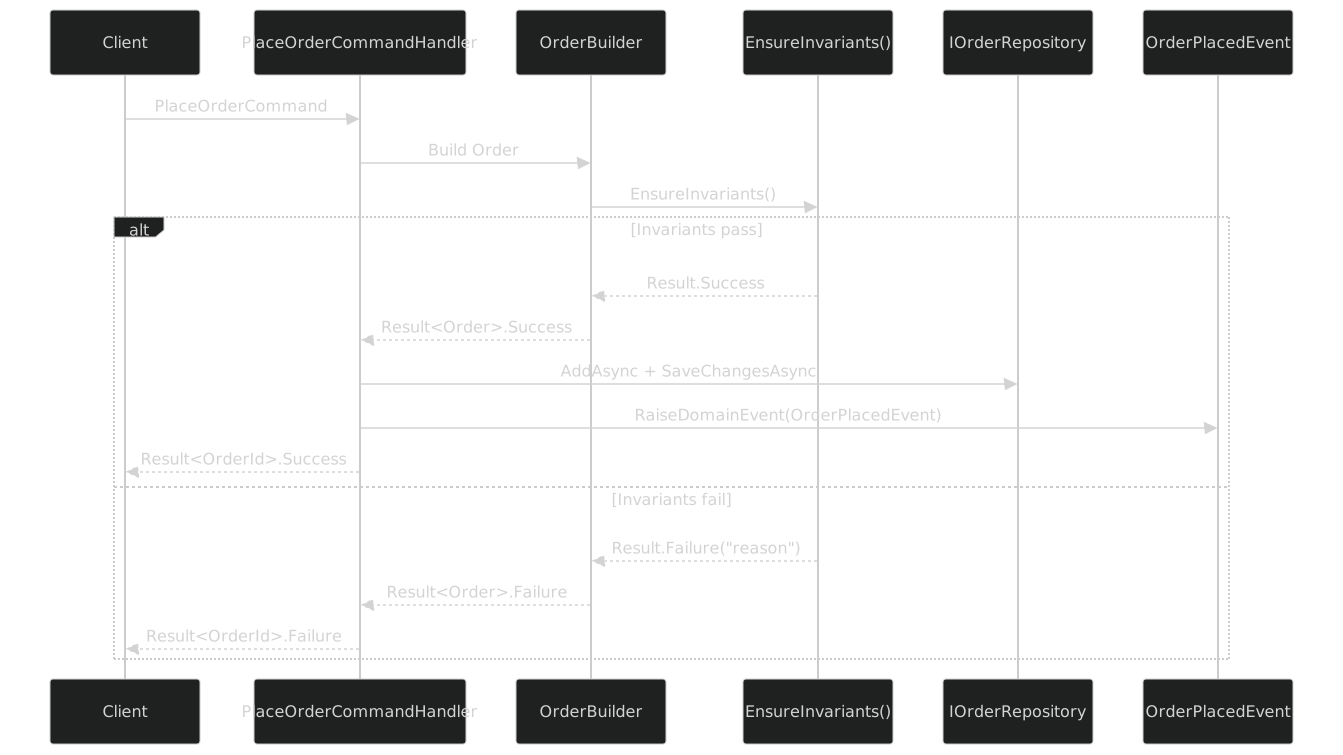
}Key: The builder calls EnsureInvariants() before returning the Order. If any invariant fails, the command returns a failure Result. No invalid aggregate ever reaches the database.
Domain Event Definition
[DomainEvent("OrderPlaced", SourceAggregate = "Order")]
public partial record OrderPlacedEvent
{
    [Property("OrderId", Required = true)]
    public partial OrderId OrderId { get; }

    [Property("CustomerId", Required = true)]
    public partial CustomerId CustomerId { get; }
}
CQRS Flow
Saga Definition
[Saga("OrderFulfillment")]
public partial class OrderFulfillmentSaga
{
    [SagaStep(1, Command = "ReserveInventory", CompensateWith = "ReleaseInventory")]
    public partial void Step1_ReserveInventory();

    [SagaStep(2, Command = "ProcessPayment", CompensateWith = "RefundPayment")]
    public partial void Step2_ProcessPayment();

    [SagaStep(3, Command = "ShipOrder", CompensateWith = "CancelShipment")]
    public partial void Step3_ShipOrder();
}
The generator produces a saga orchestrator that executes steps in order, compensating in reverse if any step fails.
BoundedContext and Anti-Corruption Layers
Declaring Bounded Contexts
[BoundedContext("Catalog", Description = "Product catalog and pricing")]
[BoundedContext("Ordering", Description = "Order processing and fulfillment")]
[BoundedContext("Identity", Description = "User authentication and authorization")]
Context Mapping
[MappingContext("CatalogToOrdering", "Catalog", "Ordering",
    MappingType = ContextMappingType.AntiCorruptionLayer)]
public partial class CatalogToOrderingMapping
{
    [MapEntity("Product", "OrderItem",
        PropertyMappings = "Name -> ProductName, Price.Amount -> UnitPrice")]
    public partial OrderItem TranslateProduct(Product source);
}Generated: CatalogToOrderingAdapter service that translates between context languages. Injected via DI. Used by cross-context command handlers.

Compile-Time Validation (Stage 1)
The Stage 1 validator evaluates MetaConstraints and emits diagnostics:
| Diagnostic | Severity | Rule |
|---|---|---|
| DDD001 | Error | Aggregate root missing [EntityId] property |
| DDD002 | Error | Entity not reachable via [Composition] from any aggregate root |
| DDD003 | Error | [Composition] across aggregate boundaries (should use [Association]) |
| DDD004 | Error | Value object not owned by any entity via [Composition] |
| DDD005 | Error | Command references non-existent aggregate root |
| DDD006 | Error | Domain event references non-existent source aggregate |
| DDD007 | Warning | Saga step references non-existent command |
| DDD100 | Warning | Aggregate root has zero [Invariant] methods |
| DDD101 | Warning | [Invariant] method does not return Result |
| DDD102 | Error | [Invariant] method is not private |
// Build output:
error DDD001: Order is an [AggregateRoot] but has no [EntityId] property
  → Add [EntityId] to a property of type OrderId

error DDD002: PaymentDetails is an [Entity] but is not reachable via
  [Composition] from any [AggregateRoot]
  → Add [Composition] on Order pointing to PaymentDetails

warning DDD100: Order is an [AggregateRoot] with zero [Invariant] methods
  → Add [Invariant] methods that return Result to enforce domain rules
Summary
The DDD DSL transforms ~120 lines of attributed partial classes into:
| Generated Artifact | Lines (approx.) | Stage |
|---|---|---|
| Entity implementations (backing fields, properties) | 200 | 2 |
| Fluent builders with invariant checking | 150 | 2 |
EnsureInvariants() aggregate method |
20 | 2 |
EF Core configurations (IEntityTypeConfiguration<T>) |
150 | 2-3 |
| Repository interfaces + implementations | 100 | 2-3 |
| CQRS command handlers | 100 per command | 2-3 |
| Domain event records | 30 per event | 2 |
| REST API controllers | 200 per aggregate | 3 |
| GraphQL schema types | 100 per aggregate | 3 |
| Total per aggregate | ~1,000-2,000 |
The developer writes the domain model. The compiler writes the plumbing. The invariants ensure correctness. The analyzers catch violations before runtime.